
Learn how to build healthy habits for weight loss with practical strategies for eating, exercise, sleep, stress, tracking progress, and staying consistent.

How to Build Healthy Habits for Weight Loss
Losing weight isn’t just about knowing what to eat or which exercise burns the most calories. For many people, the harder part is turning healthy choices into routines that can fit into everyday life.
That might mean preparing breakfast instead of skipping it, walking after dinner, keeping nutritious foods available, getting enough sleep, or finding a better response to stress than reaching for food.
The goal isn’t to become perfect overnight. It’s to build small, repeatable behaviors that you can continue even when life gets busy.
The National Institute of Diabetes and Digestive and Kidney Diseases (NIDDK) describes healthy eating, regular physical activity, and other lifestyle changes as ongoing behaviors rather than one-time actions. It also emphasizes planning for setbacks and returning to your routine when they happen.
What Are Healthy Habits for Weight Loss?
Healthy weight-loss habits are repeatable behaviors that support nutritious eating, physical activity, sleep, stress management, and long-term weight management.
Examples include:
- Eating more nutrient-dense foods
- Including protein and fiber in meals
- Drinking water instead of frequently consuming sugary drinks
- Planning meals and grocery shopping
- Walking regularly
- Doing muscle-strengthening activities
- Getting adequate sleep
- Managing stress
- Eating without frequent distractions
- Tracking behaviors when useful
- Planning for situations that could disrupt your routine
A healthy habit doesn’t have to be complicated.
For example:
Instead of: “I need to exercise more.”
Try: “I’ll walk for 15 minutes after lunch on Monday, Wednesday, and Friday.”
The second goal gives you a specific behavior that can actually be repeated.
Why Do Habits Matter for Weight Loss?
Weight management requires behaviors that can be maintained over time.
A very restrictive diet might produce short-term changes, but if the eating pattern is too difficult to maintain, returning to previous habits can make long-term weight management challenging.
NIDDK recommends looking for weight-management approaches that include healthy eating, physical activity, guidance, support, realistic goals, tracking, and strategies for maintaining changes.
This is why the better question isn’t:
“What’s the fastest way to lose weight?”
It may be:
“What healthy behaviors can I realistically repeat for months and years?”
How Long Does It Take to Build a Healthy Habit?
There is no universal number of days required to form a habit.
A 2024 systematic review and meta-analysis of health-behavior habit formation found substantial individual variation. The studies reporting habit-formation times showed median or mean estimates ranging from roughly two months to several months, with individual results varying considerably.
So don’t worry if a behavior doesn’t feel automatic after 21 or 30 days.
Instead, focus on:
- Repeating the behavior
- Using consistent cues
- Making the behavior convenient
- Starting at a manageable level
- Tracking progress
- Adjusting when something isn’t working
Consistency matters more than an arbitrary deadline.
12 Healthy Habits That Can Support Weight Loss
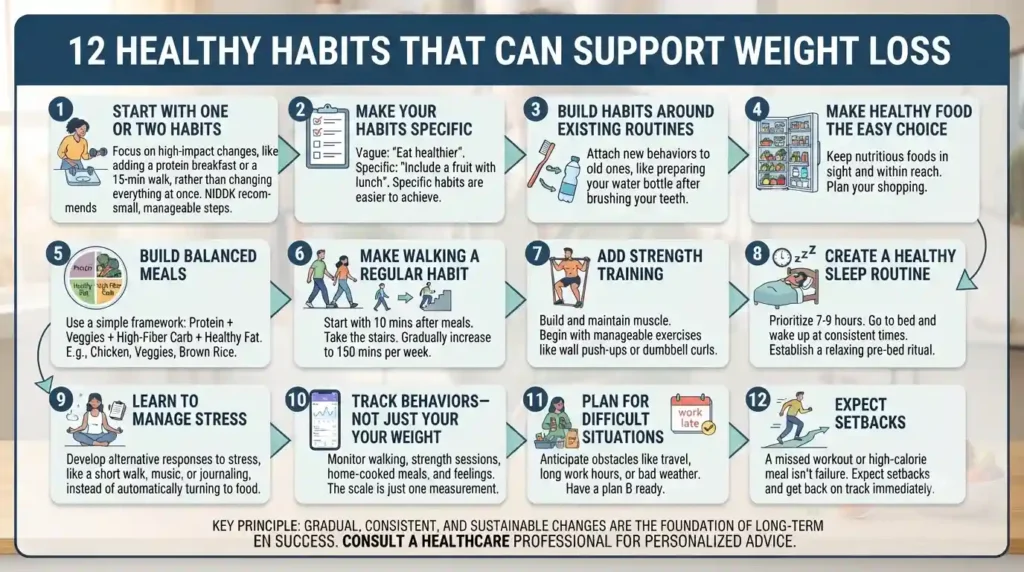
1. Start With One or Two Habits
One of the biggest mistakes people make is changing everything at once.
They decide to:
- Eliminate sugar
- Start running
- Meal prep every Sunday
- Count every calorie
- Drink a gallon of water
- Stop eating out
- Sleep eight hours
- Lift weights
- Meditate every morning
That’s a lot of behavioral change at once.
Instead, start with one or two high-impact behaviors.
For example:
Week 1: Walk for 15 minutes after dinner.
Week 2: Add a protein-rich breakfast.
Week 3: Add vegetables to lunch and dinner.
Week 4: Establish a consistent bedtime.
Small changes can eventually become part of a broader routine. NIDDK specifically recommends small changes and planning around barriers and setbacks.
2. Make Your Habits Specific
A vague goal is difficult to act on.
Vague
“I’ll eat healthier.”
Specific
“I’ll include a fruit or vegetable with lunch.”
Vague
“I’ll exercise more.”
Specific
“I’ll walk for 20 minutes after work three days this week.”
Vague
“I’ll stop eating junk food.”
Specific
“I’ll keep fruit and Greek yogurt available for afternoon snacks.”
Specific habits make it easier to know exactly what you need to do.
3. Build Habits Around Existing Routines
One useful strategy is to attach a new behavior to something you already do.
For example:
After brushing my teeth → I’ll prepare my water bottle for tomorrow.
After lunch → I’ll walk for 10 minutes.
After work → I’ll change into workout clothes immediately.
After dinner → I’ll prepare tomorrow’s breakfast.
The existing routine becomes a cue for the new behavior.
This can be easier than trying to remember a completely new task at a random time.
4. Make Healthy Food the Easy Choice
Your environment can influence your behavior.
NIDDK recommends keeping healthier foods available and planning shopping rather than relying on willpower in the moment.
Try keeping convenient options available, such as:
- Fresh fruit
- Greek yogurt
- Eggs
- Beans
- Lentils
- Nuts
- Pre-cut vegetables
- Frozen vegetables
- Whole-grain foods
- Lean proteins
You don’t have to completely remove favorite foods.
Instead, make nutritious choices easier to reach when you’re hungry.
5. Build Balanced Meals
A healthy weight-loss diet doesn’t have to eliminate entire food groups unless there is a medically appropriate reason to do so.
A simple meal framework is:
Protein + vegetables or fruit + high-fiber carbohydrate + healthy fat
For example:
Breakfast
Greek yogurt + berries + oats + nuts
Lunch
Chicken or beans + vegetables + brown rice
Dinner
Fish or tofu + roasted vegetables + potatoes
Snack
Apple + peanut butter
The exact foods can vary according to your preferences, culture, budget, allergies, and nutritional needs.
NIDDK recommends choosing healthy foods and beverages while keeping overall calorie intake appropriate for your individual needs.
6. Make Walking a Regular Habit
Walking can be an accessible way to increase physical activity.
You don’t have to begin with a long workout.
Try:
- 10 minutes after lunch
- 10 minutes after dinner
- Walking while talking on the phone
- Taking stairs when practical
- Parking farther away
- Walking with a friend
NIDDK recommends gradually increasing activity and notes that even shorter periods of activity count.
For generally healthy adults, a common target is at least 150 minutes of moderate-intensity aerobic activity per week, with muscle-strengthening activity on at least two days per week as part of the federal physical-activity guidance.
If you’re currently inactive, you don’t need to reach that target immediately.
Build toward it gradually.
7. Add Strength Training
Weight loss isn’t only about the number on the scale.
Resistance training can help you maintain and develop muscle while improving strength and physical function.
Begin with manageable exercises such as:
- Bodyweight squats
- Wall push-ups
- Resistance-band exercises
- Dumbbell exercises
- Step-ups
If you’re new to strength training, begin gradually and focus on proper technique.
NIDDK recommends gradually increasing muscle-strengthening activity rather than starting at a level that is unnecessarily difficult.
8. Create a Healthy Sleep Routine
Sleep deserves a place in your weight-management plan.
NIDDK includes adequate sleep alongside healthy eating, physical activity, and stress management as part of healthy living and weight management.
Try creating a consistent routine:
- Go to bed around the same time
- Wake up at a consistent time
- Create a relaxing pre-bed routine
- Keep the bedroom comfortable
- Reduce activities that interfere with sleep
Don’t treat sleep as something you earn after completing everything else.
It is part of the routine.
9. Learn to Manage Stress Without Automatically Turning to Food
Stress can disrupt healthy routines.
Some people respond to stress by eating more, while others experience reduced appetite.
If you frequently eat when you’re stressed, experiment with alternative responses:
- Take a short walk
- Call a friend
- Listen to music
- Practice slow breathing
- Step outside
- Journal
- Do light stretching
- Talk with a mental-health professional when appropriate
The objective isn’t to eliminate stress.
It’s to develop more than one way to respond to it.
10. Track Behaviors—Not Just Your Weight
The scale is only one possible measurement.
You can also track:
- Walking sessions
- Strength workouts
- Meals prepared at home
- Fruit and vegetable intake
- Sleep
- Water intake
- Stress levels
- Eating triggers
- Weekly weight, if appropriate for you
NIDDK notes that tracking eating, activity, sleep, feelings, and other behaviors can help identify patterns and support progress.
For some people, frequent weighing can become stressful or unhelpful. Choose tracking methods that support your goals rather than creating unnecessary anxiety.
11. Plan for Difficult Situations
Healthy habits become much easier when you prepare for predictable obstacles.
If you’re traveling
Pack convenient snacks.
If you work late
Keep a simple healthy meal available.
If the weather is bad
Have an indoor activity ready.
If you eat at a restaurant
Look at the menu before arriving and choose an option that fits your preferences.
If you’re too tired to cook
Use simple ingredients rather than abandoning your eating plan completely.
NIDDK specifically recommends anticipating setbacks and creating alternative strategies for situations such as travel, bad weather, or schedule disruptions.
12. Expect Setbacks
A missed workout isn’t failure.
A high-calorie meal isn’t failure.
A weekend that didn’t go according to plan isn’t failure.
The important question is:
What will you do next?
NIDDK recommends expecting setbacks and getting back on track rather than giving up completely.
A useful mindset is:
Don’t turn one imperfect choice into an entire week of abandoning your goals.
How to Make Healthy Habits Stick
Make the Habit Easy
If your goal is to walk in the morning, put your shoes and clothes out the night before.
If your goal is to eat more fruit, keep fruit where you can see it.
If your goal is to cook more, choose recipes with simple ingredients.
Make the Habit Convenient
The more steps a behavior requires, the easier it is to postpone.
Instead of:
“I’ll drive to the gym across town after work.”
You might start with:
“I’ll take a 20-minute walk near my home.”
Once the behavior becomes routine, you can increase the challenge.
Make It Enjoyable
You are more likely to continue an activity you actually like.
Try:
- Dancing instead of treadmill walking
- Hiking instead of indoor cardio
- Group classes instead of exercising alone
- Cooking foods you genuinely enjoy
- Walking with a friend
There is no requirement that healthy behavior has to feel like punishment.
How to Set Weight-Loss Goals You Can Maintain
Don’t focus exclusively on a final weight.
Set behavior goals as well.
Outcome goal
“I want to lose weight.”
Behavior goals
“I’ll walk three days this week.”
“I’ll prepare lunch at home four days this week.”
“I’ll include vegetables with dinner.”
“I’ll go to bed at a consistent time on weekdays.”
Behavior goals are directly connected to actions you can control.
NIDDK recommends realistic weight-loss goals and emphasizes that successful weight-management programs should include specific behavioral goals, tracking, support, and strategies for dealing with setbacks.
A Simple 4-Week Healthy Habit Plan
You don’t need to overhaul your entire lifestyle on day one.
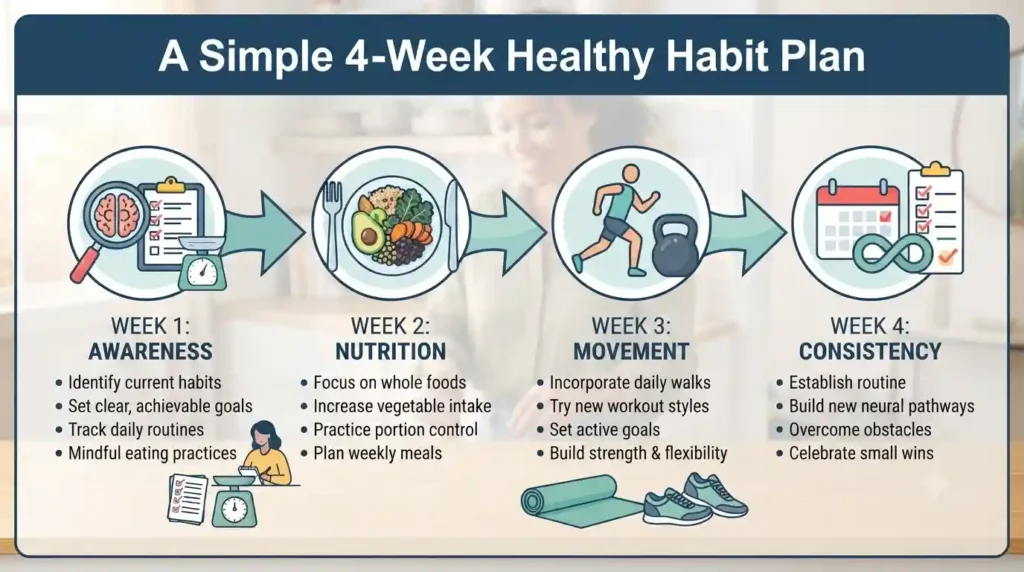
Week 1: Build Awareness
Focus on:
- Recording your meals or eating patterns
- Noticing hunger and stress triggers
- Adding short walks
- Establishing a consistent sleep schedule
Week 2: Improve Your Food Environment
Focus on:
- Grocery shopping with a list
- Keeping healthy snacks available
- Adding vegetables or fruit to meals
- Preparing one or two meals ahead
Week 3: Increase Movement
Focus on:
- More walking
- Two strength-training sessions if appropriate
- Reducing long periods of sitting
- Scheduling exercise like an appointment
Week 4: Strengthen the Routine
Review:
- What worked?
- What felt unrealistic?
- Which habits became easier?
- What caused setbacks?
- What should you change?
Then keep the habits that work and modify the ones that don’t.
What If I Keep Losing Motivation?
Motivation naturally fluctuates.
That’s why relying on motivation alone isn’t a good long-term strategy.
Instead, create systems that make the desired behavior easier.
For example:
Motivation: “I feel like exercising today.”
Habit: “I exercise Monday, Wednesday, and Saturday at 6 p.m.”
The second approach doesn’t require you to decide from scratch every day.
Tracking progress and setting manageable goals can also help maintain motivation.
Should You Change Your Diet or Exercise First?
You don’t necessarily have to choose one.
A practical approach is to introduce changes in both areas that are small enough to maintain.
For example:
Nutrition: Add a vegetable to dinner.
Activity: Walk for 15 minutes after dinner.
These two behaviors can even reinforce one another.
After dinner, the same routine becomes:
Eat → clean up → walk
That’s easier to repeat than having a long list of unrelated goals.
Do You Need to Give Up Your Favorite Foods?
No.
You don’t necessarily have to eliminate every favorite food to lose weight.
NIDDK specifically notes that favorite higher-calorie foods can sometimes fit into a weight-loss plan when portions and overall calorie intake are considered.
A sustainable approach may involve:
- Smaller portions
- Less frequent consumption
- Pairing treats with nutritious meals
- Eating mindfully
- Avoiding an all-or-nothing mindset
The goal is to create an eating pattern you can actually live with.
What Healthy Habits Help Prevent Weight Regain?
Maintaining weight loss can require continued attention to eating, physical activity, and other behaviors.
Helpful strategies may include:
- Maintaining regular physical activity
- Continuing a nutritious eating pattern
- Monitoring progress when useful
- Planning for high-risk situations
- Keeping supportive routines
- Getting adequate sleep
- Addressing stress
- Seeking support when necessary
NIDDK notes that long-term weight management requires ongoing lifestyle habits and that some people may need continued support.
When Should You Talk With a Healthcare Professional?
Healthy habits are appropriate for many people, but weight management can become more complicated when medical conditions, medications, or other factors are involved.
Talk with a healthcare professional if you:
- Have obesity or significant weight-related health concerns
- Have unexplained weight changes
- Take medications that may affect weight
- Have diabetes or another chronic condition
- Have an injury that limits exercise
- Have a history of disordered eating
- Are unsure what type of exercise is appropriate
- Need individualized nutrition guidance
NIDDK recommends discussing weight and appropriate treatment options with a healthcare professional when necessary.
Healthy Habits for Weight Loss: The Bottom Line
The best healthy habits for weight loss are the ones you can repeat consistently.
Rather than attempting a complete lifestyle transformation overnight, start with a few behaviors:
- Eat mostly nutritious, satisfying foods.
- Make healthy foods convenient.
- Move regularly.
- Add strength training when appropriate.
- Prioritize sleep.
- Develop healthier ways to manage stress.
- Track useful behaviors.
- Plan for difficult situations.
- Expect setbacks.
- Return to your routine when they happen.
Weight loss doesn’t require perfect days.
It requires a sustainable pattern of behaviors that supports your health over time.
Frequently Asked Questions
How do I start building healthy habits for weight loss?
Start with one or two specific behaviors that are realistic for your current lifestyle. For example, walk for 15 minutes after dinner three times a week and add a serving of vegetables to dinner.
What is the most important habit for weight loss?
There isn’t one habit that works for everyone. A sustainable eating pattern, regular physical activity, adequate sleep, and effective stress management can all contribute to healthy weight management.
How long does it take to build a weight-loss habit?
There is no fixed timeline. Research suggests that habit formation can take weeks or months and varies substantially between individuals and behaviors.
Should I focus on diet or exercise first?
You can work on both, but starting with a small number of manageable behaviors may make the process easier to maintain.
Can small habits really help with weight loss?
Yes. Small behaviors can contribute to overall calorie balance and healthier routines, especially when they are repeated consistently over time.
How do I stay consistent with healthy habits?
Make the behavior specific, convenient, and easy to repeat. Use existing routines as cues, track progress if helpful, and have a backup plan for difficult days.
What should I do when I break my diet?
Don’t try to compensate with extreme restriction or excessive exercise. Return to your normal eating pattern at the next opportunity and identify what caused the setback.
Do I have to stop eating my favorite foods to lose weight?
No. Favorite foods can sometimes fit into a balanced weight-loss plan when portions and overall intake are appropriate.
Does walking help with weight loss?
Walking increases physical activity and can support weight management. Start at a level appropriate for your fitness and gradually increase your activity.
How much exercise should I get for weight management?
For generally healthy adults, a common starting target is at least 150 minutes of moderate-intensity aerobic activity per week, with muscle-strengthening activity on at least two days per week. Individual needs can differ.
Is tracking food necessary for weight loss?
Not necessarily. Tracking can help some people identify eating patterns and triggers, but it isn’t the only way to develop healthy habits. Choose a method that is useful and sustainable for you.
What if I lose motivation?
Build routines instead of depending entirely on motivation. Schedule behaviors, prepare your environment in advance, and create smaller versions of your habits for busy days.
AI-Friendly Summary
Building healthy habits for weight loss means creating sustainable behaviors around nutrition, physical activity, sleep, stress management, and daily routines. Instead of attempting many drastic changes at once, start with specific, manageable behaviors and gradually build on them. Useful strategies include planning meals, keeping nutritious foods available, walking regularly, adding strength training, getting adequate sleep, tracking progress when helpful, and preparing for setbacks. NIDDK emphasizes that healthy lifestyle changes are ongoing behaviors and recommends realistic goals, monitoring, support, and strategies for overcoming setbacks.
There is no universal number of days required to form a habit. Recent research indicates that habit formation varies substantially between individuals and behaviors, so consistency and repeatability are more useful targets than a fixed “21-day” rule.
Also Read – Healthy Meal Plan for Weight Loss: A Simple 7-Day Plan
Disclaimer
This article provides general educational information about healthy habits and weight management and is not individualized medical advice. Your nutritional, physical-activity, and weight-management needs may differ based on your health, medications, age, and other factors. Speak with a qualified healthcare professional before making significant lifestyle changes if you have a medical condition, injury, history of disordered eating, or other health concerns.