
Does sleep affect weight loss? Learn how sleep may influence appetite, calorie intake, food choices, and weight management and how much sleep adults need.

Does Sleep Affect Weight Loss?
Yes, sleep can affect weight management, but sleep alone does not cause meaningful weight loss. Getting enough sleep may make weight loss easier by supporting appetite regulation, food choices, energy balance, and healthy daily routines. At the same time, the research is more nuanced than simply saying “more sleep equals more weight loss.”
Adults generally need at least 7 hours of sleep per night, and the National Institute of Diabetes and Digestive and Kidney Diseases says adults ages 18–64 should generally get 7–9 hours. Insufficient sleep is associated with weight gain and may increase hunger, calorie intake, and preference for less-healthy foods.
So if you’re eating well and exercising but consistently sleeping too little, improving your sleep may be a useful part of your overall weight-management strategy.
How Does Sleep Affect Weight Loss?
Sleep may influence weight through several interconnected pathways.
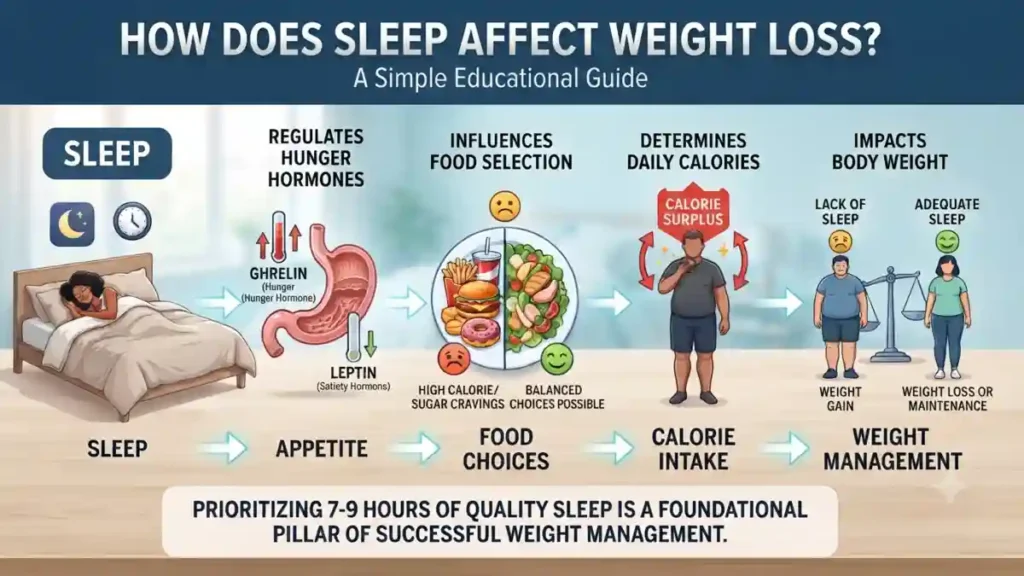
Sleep can affect:
- Hunger and appetite
- Food cravings
- Daily calorie intake
- Food choices
- Energy levels
- Physical activity
- Metabolic health
- Ability to maintain healthy routines
The relationship is not completely one-directional, however. Body weight can also affect sleep, and conditions such as obesity and sleep apnea can interfere with sleep quality.
NIDDK identifies sleep, along with diet, physical activity, medications, health conditions, genetics, and other lifestyle factors, as factors that can influence body weight.
Can Lack of Sleep Make It Harder to Lose Weight?
It can.
One important reason is that sleep deprivation may increase hunger and calorie intake.
A systematic review and meta-analysis of randomized controlled trials found that sleep restriction increased subjective hunger and was associated with greater energy intake.
NIDDK similarly reports that insufficient sleep may make people feel hungrier, consume more calories, and choose less-healthy foods and beverages more often.
That doesn’t mean one short night will automatically cause weight gain.
The concern is repeated or prolonged insufficient sleep.
Does Sleeping More Help You Lose Weight?
This is where the answer becomes more complicated.
A randomized clinical trial reported by NIH studied adults with overweight who normally slept less than 6.5 hours per night. Participants assigned to a sleep-extension intervention increased their sleep by about 1.2 hours and consumed approximately 270 fewer calories per day on average than the control group.
That’s encouraging, but it does not prove that simply sleeping longer will produce a predictable amount of weight loss for everyone.
A newer 2026 systematic review of 30 studies found that evidence regarding sleep and weight-loss outcomes remains mixed. Sleep restriction may impair fat loss, while sleep satisfaction and sleep efficiency may support weight loss, but evidence concerning sleep duration itself was inconsistent.
Bottom line: Better sleep may support weight management, but it should be viewed as one part of a broader strategy rather than a standalone weight-loss treatment.
How Many Hours Should You Sleep for Weight Loss?
For most adults, a practical target is 7–9 hours per night.
NIDDK recommends:
- Adults ages 18–64: 7–9 hours
- Adults 65 and older: 7–8 hours
The goal isn’t to sleep as many hours as possible.
Instead, aim for enough consistent, good-quality sleep.
The CDC reported that 30.5% of U.S. adults slept fewer than 7 hours on average in 2024, highlighting how common insufficient sleep remains.
Why Does Sleep Loss Increase Hunger?
Several biological and behavioral mechanisms may contribute.
When you’re tired, your appetite and food-reward systems can change. Research has found that sleep restriction can increase subjective hunger and energy intake.
There’s also a simple behavioral explanation:
If you’re awake for more hours, especially late at night, you have more opportunities to eat.
You may also feel too tired to prepare a balanced meal or exercise.
So sleep deprivation can influence weight management through both biology and behavior.
Does Sleep Affect Cravings?
It can.
Sleep restriction has been associated with increased appetite and higher calorie intake, and laboratory research suggests that insufficient sleep can increase cravings for energy-dense foods.
This can create a frustrating cycle:
Less sleep → more fatigue → stronger hunger/cravings → more calories → harder weight management
This doesn’t happen to everyone in exactly the same way, but it is one reason sleep deserves attention when you’re trying to lose weight.
Does Sleep Affect Metabolism?
Yes, sleep is connected to metabolic health, but the relationship is complex.
NIH reports that sleep has important effects on metabolism and that insufficient sleep can impair the body’s response to insulin.
A meta-analysis of randomized trials also found that sleep restriction affected appetite, energy intake, and insulin sensitivity.
However, it would be inaccurate to say that getting extra sleep dramatically “boosts your metabolism.”
Sleep is better understood as one component of healthy metabolic regulation.
Does Sleeping Too Little Cause Weight Gain?
Insufficient sleep is associated with weight gain and obesity, but “cause” is too simplistic for every individual.
Observational studies consistently show an association between short sleep and excess body weight, while controlled trials provide more nuanced results.
Importantly, a 2026 pooled analysis of randomized trials found that restricting sleep by about 78 minutes per night for six weeks increased body weight by approximately 0.45 kg and waist circumference by approximately 0.52 cm compared with adequate sleep. The researchers described the effects as modest and noted limitations, including the relatively short intervention period.
This newer evidence strengthens the case that prolonged short sleep can contribute to unfavorable weight-related changes, while still leaving important questions about long-term effects.
Can Poor Sleep Make It Harder to Maintain Weight Loss?
Possibly.
Weight management isn’t only about losing weight; maintaining changes over time is also important.
The evidence on sleep during weight-loss interventions remains mixed. A 2026 systematic review found that sleep restriction may impair fat loss, while findings for sleep duration and weight-loss success were inconsistent across studies.
That means improving sleep is sensible, but it shouldn’t be presented as a guaranteed way to prevent weight regain.
Sleep Quality vs. Sleep Quantity
Getting enough hours is important, but sleep quality matters too.
For example, someone may spend eight hours in bed but repeatedly wake up during the night.
Poor sleep quality can leave you feeling tired despite spending enough time in bed.
Signs that your sleep may not be restorative include:
- Frequent nighttime awakenings
- Difficulty falling asleep
- Waking up feeling unrefreshed
- Excessive daytime sleepiness
- Loud snoring
- Gasping or choking during sleep
Persistent sleep problems deserve attention rather than simply trying to spend more time in bed.
What Is the Best Time to Go to Sleep for Weight Loss?
There is no scientifically established bedtime that guarantees weight loss.
Consistency is generally more useful than chasing a particular clock time.
For example, if you need to wake at 6:30 a.m., regularly going to bed at a time that allows approximately 7–9 hours of sleep is more important than trying to follow a specific “weight-loss bedtime.”
Sleep timing and circadian rhythms may influence metabolic health, but the evidence isn’t strong enough to claim that one bedtime works best for everyone. Current research on sleep timing and weight-loss outcomes remains limited.
Does Sleeping After Eating Cause Weight Gain?
Not necessarily.
Simply going to sleep after eating doesn’t automatically cause body fat gain.
Overall calorie intake, dietary quality, physical activity, sleep, and many other factors influence body weight.
However, consistently eating large amounts of calorie-dense food late at night may make weight management more difficult for some people, particularly if late-night eating adds calories beyond their needs.
NIH notes that prolonged wakefulness can increase opportunities for nighttime eating and that circadian timing may influence metabolic processes.
Can You Lose Weight While Sleeping?
Your body continues using energy while you sleep, but sleep itself isn’t a weight-loss method.
Your body performs many functions during sleep, including tissue repair and regulation of physiological processes.
However, claims that a particular drink, supplement, sleeping position, or “nighttime fat-burning trick” will cause substantial fat loss while you sleep are generally misleading.
The more realistic benefit is that adequate sleep can support the behaviors and physiological processes involved in healthy weight management.
8 Ways to Improve Sleep While Trying to Lose Weight
1. Set a Consistent Sleep Schedule
Try to go to bed and wake up around the same time each day.
Consistency can make it easier to establish a regular sleep routine.
2. Give Yourself Enough Time in Bed
If you’re regularly sleeping only five or six hours, moving toward at least seven hours is a reasonable starting goal for most adults.
Don’t sacrifice sleep to fit in another workout or household task whenever you can avoid it.
3. Create a Dark, Quiet Bedroom
A comfortable sleeping environment can make it easier to stay asleep.
Reduce unnecessary light and noise where possible.
4. Limit Late-Night Screen Use
Bright light and stimulating activities immediately before bed can make winding down more difficult for some people.
Consider creating a short period before bedtime for quieter activities.
5. Be Careful With Late Caffeine
Caffeine can interfere with sleep, especially when consumed later in the day.
Individual sensitivity varies.
6. Exercise Regularly
Regular physical activity supports overall health and can also support healthy sleep.
However, if vigorous exercise immediately before bed makes it harder for you to sleep, move your workout earlier.
7. Avoid Using Food as a Sleep Strategy
Large late-night meals may be uncomfortable and can add unnecessary calories.
If you’re genuinely hungry, choose a reasonable snack that fits your overall eating plan rather than trying to ignore persistent hunger.
8. Address Persistent Sleep Problems
If you’re consistently unable to sleep well, don’t assume that lack of discipline is the problem.
Sleep disorders, medications, mental health conditions, work schedules, and other medical issues can affect sleep.
Does Sleep Affect Weight Loss More Than Exercise?
It’s not useful to rank sleep and exercise as competing weight-loss tools.
Both matter.
Exercise can increase energy expenditure, improve physical fitness, support muscle retention during weight loss, and provide numerous health benefits.
Sleep supports recovery, appetite regulation, energy, and metabolic health.
A sustainable weight-management plan generally works better when it addresses:
Nutrition + physical activity + sleep + behavior + overall health
rather than relying on one factor.
What If You’re Eating in a Calorie Deficit but Not Losing Weight?
If you’re consistently trying to lose weight but progress has stalled, sleep is one factor worth examining—but it isn’t the only possible explanation.
Consider:
- Portion sizes
- Liquid calories
- Weekend eating
- Physical activity
- Changes in exercise
- Stress
- Sleep duration
- Sleep quality
- Medications
- Medical conditions
- How long you’ve been dieting
Weight also naturally fluctuates because of changes in water, glycogen, digestion, and other factors.
Don’t conclude that poor sleep is automatically the reason you’re not losing weight.
What About Sleep Apnea and Weight?
Sleep apnea deserves particular attention.
Obstructive sleep apnea can disrupt sleep repeatedly throughout the night and may cause significant daytime fatigue.
Excess body weight can increase the risk of obstructive sleep apnea, while sleep apnea itself can make healthy routines more difficult because poor sleep can leave a person tired during the day.
If you have symptoms such as loud habitual snoring, witnessed pauses in breathing, gasping during sleep, or excessive daytime sleepiness, talk with a healthcare professional.
Don’t attempt to treat suspected sleep apnea solely by changing your diet or buying an unverified supplement.
Can Better Sleep Replace Diet and Exercise?
No.
Better sleep is helpful, but it cannot replace an appropriate eating pattern and regular physical activity.
Think of sleep as a supporting pillar of weight management, not a substitute for calorie balance, nutritious food, or exercise.
Does Sleeping More Burn More Calories?
Not necessarily.
The goal of improving sleep isn’t to burn large numbers of calories during sleep.
In fact, the strongest evidence for sleep’s role in weight management may involve appetite, food intake, energy balance, and metabolic regulation, rather than dramatically increasing calorie expenditure.
A Simple Sleep-and-Weight-Loss Routine
Try this basic routine:
Morning
- Wake at a consistent time
- Get regular daytime activity
- Eat a balanced breakfast if you prefer one
Afternoon
- Stay physically active
- Avoid excessive late-day caffeine if it affects your sleep
Evening
- Eat a balanced dinner
- Avoid unnecessarily large late-night meals
- Begin winding down before bed
- Reduce bright light and stimulating activities
Night
- Aim for approximately 7–9 hours of sleep
- Keep your bedroom dark, quiet, and comfortable
The objective isn’t perfection.
Consistency matters more than one perfect night of sleep.
Does Sleep Affect Weight Loss? The Bottom Line
Yes, sleep can affect weight loss and weight management.
Insufficient sleep may increase hunger, calorie intake, cravings, and other behaviors that make weight management more difficult. Controlled research also suggests that prolonged short sleep can contribute to modest increases in body weight and waist circumference.
But sleep isn’t a magic weight-loss treatment.
The most realistic approach is to combine adequate sleep, a nutritious eating pattern, regular physical activity, and sustainable calorie management.
For most adults, aiming for 7–9 hours of sleep per night is a reasonable target.
Frequently Asked Questions
Does sleep really affect weight loss?
Yes. Sleep can influence appetite, calorie intake, food choices, energy balance, and metabolic health. However, the effect varies between people, and sleep alone doesn’t guarantee weight loss.
How many hours should I sleep to lose weight?
Most adults should aim for at least 7 hours of sleep, with NIDDK generally recommending 7–9 hours for adults ages 18–64.
Can lack of sleep cause weight gain?
Insufficient sleep is associated with weight gain and obesity, and newer randomized evidence suggests prolonged short sleep can contribute to modest increases in body weight.
Does sleeping more burn fat?
Not directly. Adequate sleep may support weight management by influencing appetite, food intake, and metabolic processes, but it shouldn’t be considered a fat-burning treatment.
Can I lose weight if I don’t sleep enough?
You may still lose weight while sleeping too little, but insufficient sleep can make weight management harder for some people by increasing hunger, calorie intake, fatigue, and cravings.
Does sleep affect belly fat?
Sleep is associated with body composition and waist circumference. Recent randomized evidence found that prolonged short sleep modestly increased waist circumference, but sleep alone isn’t a specific treatment for belly fat.
What is the best sleep schedule for weight loss?
There is no universally proven sleep schedule that guarantees weight loss. Aim for a consistent schedule that allows you to get adequate sleep.
Does poor sleep increase hunger?
Yes. Randomized research has found that sleep restriction can increase subjective hunger and energy intake.
Does sleep affect metabolism?
Yes. Sleep is connected to metabolic regulation, and insufficient sleep can affect insulin sensitivity and other metabolic processes.
Can sleeping too much cause weight gain?
The relationship between very long sleep and weight is complicated. Observational associations don’t prove that sleeping longer directly causes weight gain. If you’re regularly sleeping far longer than expected or remain exhausted despite adequate time in bed, discuss it with a healthcare professional.
Should I prioritize sleep or exercise for weight loss?
You don’t necessarily need to choose. Both are valuable. A sustainable weight-management plan should include appropriate nutrition, physical activity, and adequate sleep.
Why am I still tired after getting 8 hours of sleep?
Possible reasons include poor sleep quality, frequent awakenings, an irregular schedule, medications, stress, or a sleep disorder. Persistent excessive daytime sleepiness should be discussed with a healthcare professional.
Friendly Summary
Sleep can affect weight loss, but it is not a standalone weight-loss treatment. Insufficient sleep may increase hunger, calorie intake, cravings, and metabolic problems, potentially making weight management more difficult. NIDDK recommends 7–9 hours of sleep for adults ages 18–64, while current research suggests that prolonged short sleep may contribute to modest weight gain.
The evidence on whether simply increasing sleep duration produces long-term weight loss remains mixed. The most practical strategy is to combine adequate sleep with a nutritious diet, regular physical activity, and sustainable weight-management habits.
Disclaimer
This article provides general educational information about sleep and weight management and is not individualized medical advice. If you have persistent insomnia, excessive daytime sleepiness, loud snoring, pauses in breathing during sleep, or other ongoing sleep problems, speak with a qualified healthcare professional.
Also Read More –How to Lose Weight Naturally: 8 Evidence-Based Strategies