
Discover the best exercise for weight loss, including walking, cycling, swimming, strength training, and interval workouts, plus a beginner-friendly weekly plan.

Best Exercise for Weight Loss
If you’re searching for the best exercise for weight loss, you may be expecting one workout to stand above the rest. In reality, there isn’t a single exercise that is best for everyone.
The most useful exercise for weight loss is usually one you can perform consistently, safely, and often enough to contribute meaningfully to your overall activity. Brisk walking, cycling, swimming, jogging, aerobic workouts, and strength training can all have a place in a weight-management plan. Physical activity can increase the calories your body uses, while regular activity also provides important health benefits independent of changes on the scale.
For many beginners, brisk walking is an excellent starting point, while combining aerobic exercise with strength training can create a more complete fitness routine.
What Is the Best Exercise for Weight Loss?
There is no universally “best” exercise for losing weight.
Instead, consider three factors:
- How much energy the activity uses
- How consistently you can perform it
- Whether you enjoy it enough to keep doing it
Research does not establish that simply choosing the highest-intensity workout automatically produces better long-term weight loss. Adherence matters, and very demanding exercise can be difficult for some people to maintain.
A practical hierarchy for many adults is:
| Exercise | Best for | Beginner-friendly? |
| Brisk walking | Easy, sustainable activity | Yes |
| Cycling | Cardio with lower impact | Yes |
| Swimming | Full-body, lower-impact cardio | Yes |
| Jogging | Higher-intensity cardio | Sometimes |
| Strength training | Building and maintaining muscle | Yes |
| Interval training | Time-efficient vigorous exercise | Intermediate |
| Dancing | Enjoyable cardio | Yes |
| Hiking | Cardio + outdoor activity | Yes |
1. Walking
Walking is one of the best starting exercises for weight loss.
You don’t need a gym membership or complicated equipment. You can walk outdoors, on a treadmill, at work, or around your neighborhood.
Brisk walking counts as moderate-intensity physical activity. NIDDK recommends gradually working toward at least 150 minutes of moderate activity per week for general health.
How to start
If you’re currently inactive:
- Start with 10–15 minutes.
- Walk at a comfortable pace.
- Gradually increase your duration.
- Eventually work toward longer walks.
- Add hills or a faster pace as your fitness improves.
You don’t have to complete your entire day’s activity in one session. Short periods of activity can contribute to your weekly total.
Best for: beginners, people returning to exercise, and people who want a simple low-cost option.
2. Cycling
Cycling can provide moderate or vigorous aerobic activity depending on how hard you ride.
Options include:
- Outdoor cycling
- Stationary cycling
- Spin classes
- Recumbent bikes
Cycling can be particularly useful for people who prefer it to walking or running.
Beginner approach
Start with 15–20 minutes at a comfortable intensity. As your fitness improves, gradually increase the duration or resistance.
Best for: people who enjoy cycling and want a cardio option that can be adapted to different fitness levels.
3. Swimming
Swimming and water-based exercise can provide aerobic activity while placing less impact on the joints than activities such as running.
A swimming workout might include:
- Easy swimming
- Water walking
- Water aerobics
- Alternating swimming and rest intervals
The appropriate intensity depends on your swimming ability.
Best for: people who enjoy water exercise or want a lower-impact aerobic option.
4. Jogging or Running
Running generally requires more effort than walking and can be an efficient way to increase aerobic activity.
However, running isn’t automatically better simply because it is harder.
If you’re new to exercise, jumping directly into frequent running can be unnecessarily demanding.
A gradual walk-jog approach may be more appropriate.
For example:
5 minutes: easy walking
1 minute: light jogging
2–3 minutes: walking
Repeat several times.
Over time, you can gradually increase the jogging intervals if your body tolerates them.
Best for: people who enjoy running and have built enough fitness to tolerate higher-impact activity.
5. Strength Training
Strength training deserves a place in a weight-loss exercise plan even though it isn’t primarily an aerobic calorie-burning activity.
Resistance exercises include:
- Squats
- Lunges
- Push-ups
- Rows
- Resistance-band exercises
- Dumbbell exercises
- Weight machines
Strength training can help maintain muscle mass while you’re losing weight. NIDDK notes that muscle-strengthening activity can help maintain muscle mass and should be performed at least two days per week.
Beginner strength routine
Try:
- Squats — 8–12 repetitions
- Wall or incline push-ups — 8–12
- Resistance-band rows — 8–12
- Glute bridges — 10–15
- Plank — 10–30 seconds
Start with manageable resistance and focus on controlled technique.
6. Interval Training
Interval training alternates periods of higher effort with easier recovery periods.
For example:
- 30 seconds faster walking
- 90 seconds easy walking
- Repeat 6–8 times
You can use intervals with:
- Walking
- Cycling
- Running
- Rowing
- Swimming
High-intensity exercise isn’t automatically superior for weight loss. Research has found limited conclusive evidence that high-intensity exercise consistently produces better weight or fat loss than moderate-intensity exercise, while greater intensity may be harder for some people to maintain.
Best for: people with an established fitness base who enjoy higher-intensity workouts.
7. Dancing
Dancing can turn exercise into a recreational activity.
Depending on the style and intensity, dancing can provide moderate or vigorous physical activity.
Try:
- Dance classes
- Zumba-style workouts
- Home dance workouts
- Social dancing
The major advantage is simple: you’re more likely to keep exercising if you enjoy it.
NIDDK recommends choosing activities you enjoy because doing something you like can make it easier to stay active.
8. Hiking
Hiking combines walking with changes in terrain and elevation.
A flat trail may provide moderate activity, while steep or uneven terrain can make the workout considerably harder.
Hiking can also be an enjoyable way to increase your total weekly movement.
Best for: people who enjoy outdoor activities.
Is Cardio or Strength Training Better for Weight Loss?
The answer isn’t necessarily one or the other.
Cardio is useful for increasing aerobic fitness and physical activity.
Strength training helps challenge muscles and can help maintain muscle mass during weight loss.
A combination can therefore be a practical approach.
For example:
Monday: Strength training
Tuesday: Brisk walking
Wednesday: Rest or light activity
Thursday: Strength training
Friday: Brisk walking or cycling
Saturday: Longer walk or hike
Sunday: Rest
This approach doesn’t require extreme workouts.
How Much Exercise Do You Need to Lose Weight?
There isn’t one exact amount that guarantees weight loss.
NIDDK states that many people may work toward 150 minutes or more of aerobic activity per week, while some people may need more activity to lose weight and maintain weight loss. Its guidance also notes that 300 minutes per week may be useful for weight management for some individuals.
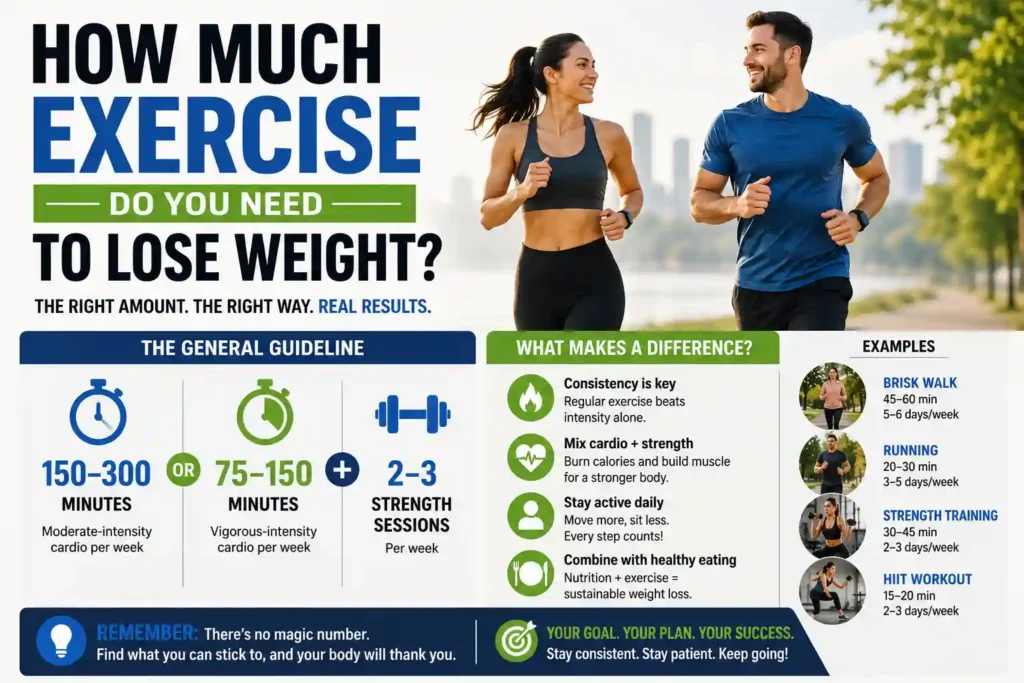
Your needs depend on factors such as:
- Current activity level
- Body size
- Age
- Diet
- Fitness level
- Health conditions
- Exercise intensity
- Ability to maintain the routine
More exercise isn’t always better if it causes excessive fatigue, pain, or burnout.
Can You Lose Weight With Exercise Alone?
Exercise can contribute to weight loss, but it isn’t always enough by itself.
Physical activity increases energy expenditure, but food intake also affects overall energy balance. NIDDK describes successful weight-management approaches as typically combining an appropriate eating plan with regular physical activity and behavioral support.

Research also suggests that exercise alone can produce weight loss, but the amount may be modest and individual responses vary. Combining physical activity with dietary changes can be more effective for weight management.
That doesn’t mean you need a highly restrictive diet.
A sustainable eating pattern is generally more useful than trying to “out-exercise” your food intake.
What Is the Best Exercise for Belly Fat?
There isn’t a specific exercise that selectively removes belly fat.
Exercises such as:
- Crunches
- Planks
- Leg raises
- Sit-ups
can strengthen abdominal muscles, but they don’t guarantee targeted fat loss from the abdomen.
For reducing overall body fat, the bigger picture matters:
- Appropriate calorie intake
- Regular physical activity
- Aerobic exercise
- Strength training
- Adequate sleep
- Sustainable habits
Avoid programs promising that one exercise will specifically “burn belly fat.”
Best Exercise for Beginners Trying to Lose Weight
If you’re starting from a low fitness level, walking is often the simplest place to begin.
A beginner could try:
Week 1
Walk 10–15 minutes, 5 days.
Week 2
Walk 15–20 minutes, 5 days.
Week 3
Walk 20–25 minutes, 5 days.
Week 4
Work toward 25–30 minutes, depending on your fitness and schedule.
You can eventually add:
- Faster walking
- Hills
- Longer walks
- Cycling
- Strength training
The goal isn’t to make the first workout extremely difficult.
The goal is to create a routine you can maintain.
Best Exercise Schedule for Weight Loss
Here’s one example for a generally healthy beginner:
| Day | Activity |
| Monday | 30-minute brisk walk |
| Tuesday | Full-body strength training |
| Wednesday | 30-minute walk |
| Thursday | Rest or light activity |
| Friday | 30-minute brisk walk |
| Saturday | Strength training + short walk |
| Sunday | Rest or easy walk |
This is only an example.
Your schedule should be adjusted according to your fitness, health, availability, and preferences.
How to Make Exercise More Effective for Weight Loss
Increase Activity Gradually
Don’t go from almost no activity to intense daily workouts.
Build your workload progressively.
Choose Sustainable Exercises
An exercise you enjoy and perform regularly can be more useful than a theoretically “optimal” workout you abandon after two weeks.
Add Strength Training
Include muscle-strengthening activity at least twice per week.
Move More Throughout the Day
Exercise isn’t limited to formal workouts.
You can also:
- Walk during breaks
- Take stairs when appropriate
- Walk while talking on the phone
- Park farther away
- Do household chores
- Spend less time sitting
NIDDK emphasizes that even short periods of activity can contribute toward physical-activity goals.
Track Your Progress
You can track:
- Workout duration
- Steps
- Distance
- Resistance used
- Repetitions
- Weekly activity
Tracking can help you identify whether your activity is becoming more consistent.
Common Weight-Loss Exercise Mistakes
Doing Only Extreme Workouts
You don’t need exhausting workouts every day.
Exercising to “Earn” Food
Exercise should support your health rather than become a punishment for eating.
Ignoring Recovery
Rest is part of a sustainable exercise program.
Increasing Activity Too Quickly
Rapid increases can make soreness and injury more likely.
Expecting the Scale to Change Immediately
Body weight can fluctuate from day to day for many reasons.
Look at longer-term trends rather than judging your progress from one weigh-in.
Choosing Exercise You Hate
If you dread every workout, maintaining the routine may become difficult.
Choose activities you genuinely enjoy whenever possible.
Safety Tips Before Starting
If you’ve been inactive for a long time, start slowly.
NIDDK recommends talking with a healthcare professional if you have a health problem or injury that may affect your ability to exercise. People with certain chronic conditions or symptoms may need individualized guidance about the appropriate type and amount of physical activity.
Stop exercising and seek appropriate medical attention for concerning symptoms such as severe chest pain, fainting, or severe shortness of breath.
Frequently Asked Questions
What is the best exercise for weight loss?
There is no single best exercise for everyone. Brisk walking, cycling, swimming, jogging, strength training, and other activities can support weight management. The best choice is one you can perform safely and consistently.
Is walking the best exercise for losing weight?
Walking is an excellent starting option because it is accessible, inexpensive, and easy to adjust in duration and intensity. It can contribute to the recommended weekly physical-activity target.
Is cardio or strength training better for weight loss?
Both can be useful. Cardio increases aerobic activity, while strength training challenges muscles and can help maintain muscle mass. A combination is often a practical approach.
How many minutes should I exercise to lose weight?
There is no universal number that guarantees weight loss. Many adults can work toward at least 150 minutes of moderate aerobic activity per week, while some people may need more activity for weight loss or weight-loss maintenance.
Can I lose belly fat with exercise?
Exercise can contribute to overall fat loss, but you cannot reliably choose where your body loses fat first. Abdominal exercises strengthen the core but don’t guarantee targeted belly-fat loss.
Is walking or running better for weight loss?
Running generally requires more effort than walking, but that doesn’t automatically make it better for every person. Walking may be easier to perform consistently, particularly for beginners.
Can I lose weight without going to the gym?
Yes. Walking, cycling, running, dancing, bodyweight exercises, and resistance-band workouts can all be performed without a traditional gym.
Should I exercise every day to lose weight?
Not necessarily. A balanced routine can include exercise days, lighter activity, and recovery days. The appropriate schedule depends on your fitness level and overall health.
Does strength training burn fat?
Strength training uses energy and can support body composition and muscle maintenance, but it shouldn’t be described as a guaranteed fat-burning solution. It works best as part of a broader physical-activity and nutrition plan.
Is HIIT better than walking for weight loss?
Not necessarily. High-intensity interval training can be useful, but evidence does not establish that higher intensity is universally superior for weight loss. It may also be less sustainable for some people.
Friendly Summary
The best exercise for weight loss is not one specific workout. For most people, the best choice is an activity that can be performed safely and consistently. Brisk walking, cycling, swimming, jogging, dancing, and other aerobic activities can help increase physical activity, while strength training can help maintain muscle mass. A combination of aerobic and muscle-strengthening exercise is a practical approach for many adults.
Adults should generally work toward at least 150 minutes of moderate-intensity aerobic activity per week and muscle-strengthening activity on at least two days per week. Some people may benefit from more activity for weight management.
Exercise can support weight loss, but it works as part of a broader weight-management strategy that includes an appropriate eating pattern and sustainable lifestyle habits.
Read More –Healthy Meal Plan for Weight Loss: A Simple 7-Day Plan