
Learn how to identify hidden calories in meals, including cooking oils, sauces, drinks, toppings, restaurant portions and serving-size differences.
Introduction
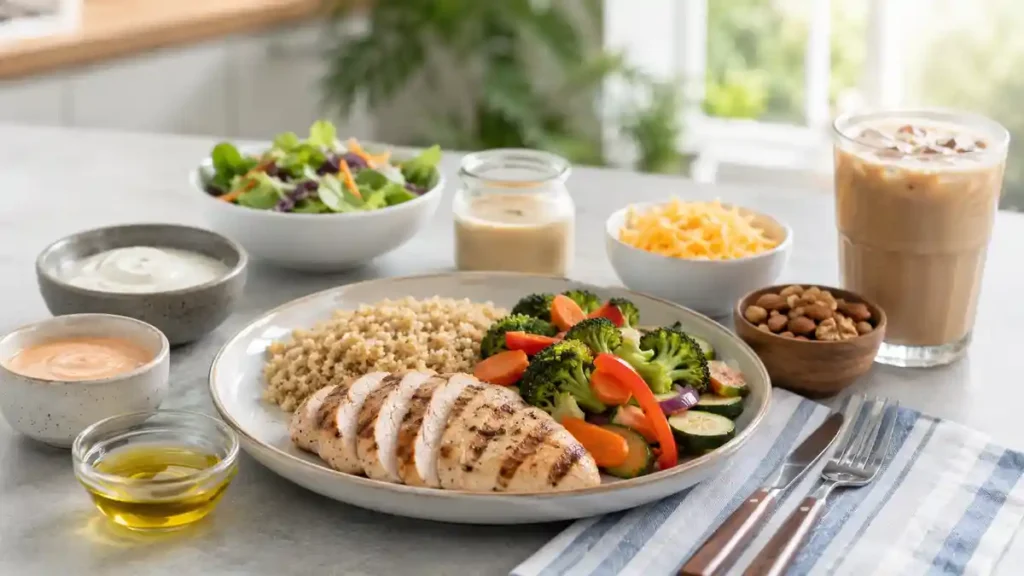
You can build a meal that looks healthy on the plate and still underestimate how much energy it provides. A salad can contain dressing, cheese, nuts and oil. A grilled dinner may have been cooked with butter or oil. A morning coffee can become a substantial source of calories once sweeteners, flavored syrups and cream are added.
These are often called hidden calories. The calories are not actually invisible, but they can be easy to overlook because they come from ingredients, drinks, toppings, preparation methods or portions that are not obvious from the main food itself.
If you are trying to understand your eating pattern, learning to identify hidden calories in meals can make your food estimates more realistic. It does not mean you need to count every calorie or avoid calorie-dense foods. Instead, the goal is to notice the small additions that can meaningfully change a meal’s total energy, particularly when they are added repeatedly throughout the day.
What Are Hidden Calories?
Hidden calories are calories that are easy to miss when estimating the total energy in a meal. They commonly come from ingredients added during cooking or serving rather than from the main food itself.
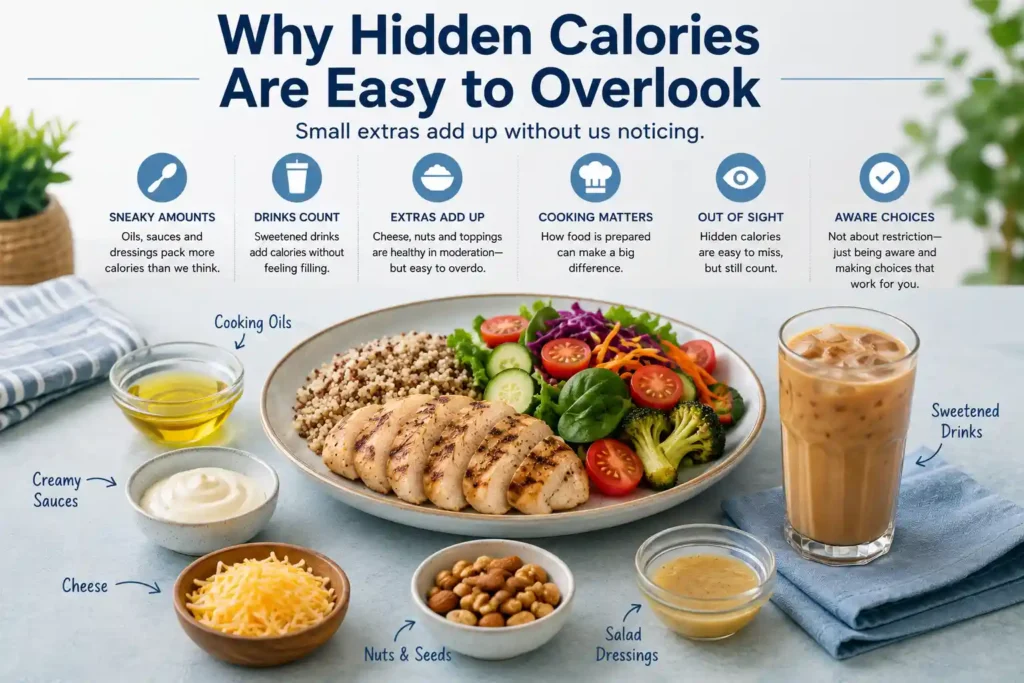
For example, someone may estimate the calories in a chicken-and-vegetable dinner by considering the chicken and vegetables while forgetting the oil used in the pan, the sauce on top and the beverage served with the meal. Each addition may seem small, but several additions together can change the overall calorie estimate.
Research on dietary assessment has found that people can have difficulty identifying and estimating less visible energy-dense ingredients such as oils, dressings and condiments. PubMed Central (PMC)
There is also an important distinction between a serving and a portion. A serving is the amount listed on a Nutrition Facts label, while a portion is how much you actually choose to eat. They are not necessarily the same.
Why Hidden Calories Are Easy to Overlook
Calories are easiest to underestimate when the food does not look particularly calorie-dense or when an ingredient is mixed into another food.
- Added fats are easy to miss: Oil and butter can disappear into a pan, sauce or roasted vegetables.
- Liquid calories are easy to drink quickly: Coffee beverages, soda, sweet tea, smoothies and other drinks may contain substantial calories without creating the same sense of fullness as solid food.
- Condiments are perceived as extras: A spoonful of mayonnaise, dressing or sauce may not feel like part of the meal, even though it contributes to the meal’s total energy.
- Restaurant preparation is less visible: You may not know exactly how much oil, butter, sauce or cheese was used.
- Serving sizes can be confusing: Nutrition information may describe one serving even when a package or meal contains multiple servings.
15 Common Sources of Hidden Calories in Meals
1. Cooking Oil
Oil is one of the most important ingredients to notice when estimating calories because it is concentrated in energy and can be difficult to see after cooking. It may be used to sauté vegetables, sear meat, roast foods or prevent sticking.
You do not need to eliminate oil. Instead, consider whether a meal was cooked with oil and roughly how much was used. Measuring oil when cooking at home can also make your calorie estimates more consistent.
2. Butter and Ghee
Butter and ghee can be added to toast, vegetables, grains, potatoes, meat and cooked dishes. They can also be incorporated into restaurant meals without being obvious on the finished plate.
If a meal tastes particularly rich or buttery, it is worth considering the cooking fat as part of the meal rather than treating it as an insignificant extra.
3. Salad Dressing
A vegetable-heavy salad may look light while its dressing adds a substantial amount of energy. Creamy dressings, oil-based vinaigrettes and some specialty dressings can all contribute calories.
A practical approach is to ask for dressing on the side at restaurants or measure dressing at home. This lets you control the amount without giving up the flavor.
4. Mayonnaise and Aioli
Mayonnaise-based spreads can be easy to overlook in sandwiches, burgers, wraps and salads. Aioli and similar creamy sauces can play the same role.
When estimating a meal, include spreads and sauces rather than counting only the bread and protein.
5. Sauces and Gravies
Barbecue sauce, creamy pasta sauces, cheese sauces, gravy, pesto and other sauces can add calories while also changing the nutritional profile of a meal.
This does not make sauces unhealthy by definition. The useful habit is simply to recognize them as ingredients that belong in the overall meal estimate.
6. Cheese
Cheese can be nutritious and provides protein and calcium, but it is also relatively calorie-dense. A small amount sprinkled over pasta, eggs, salad, soup or a sandwich can add more energy than expected.
If you are tracking calories, consider whether cheese is part of the dish and whether the amount is a thin sprinkle, a slice or a larger serving.
7. Nuts and Seeds
Nuts and seeds provide protein, unsaturated fats and other nutrients, but their calorie density makes portions worth noticing. A handful can be considerably different from a measured serving.
The goal is not to avoid nuts. If you are trying to understand your intake, pay attention to the amount added to oatmeal, yogurt, salads, trail mix or snacks.
8. Nut Butter
Peanut butter, almond butter and other nut butters are another example of a nutritious food that can be easy to underestimate. A spoonful added to toast, oatmeal, fruit or a smoothie can increase the meal’s energy considerably.
For a more accurate estimate, check the label and compare the listed serving size with the amount you actually use.
9. Sugary Drinks
Regular soda, sweetened tea, lemonade, sports drinks and other sugar-sweetened beverages can add calories without being perceived as part of the meal. The CDC notes that sugary drinks are an important source of added sugars in the U.S. diet.
For example, the CDC reports that a 12-ounce regular soda contains more than 10 teaspoons, or about 42 grams, of added sugar and about 150 calories.
Choosing water or an unsweetened beverage is one simple way to reduce liquid calories when that fits your preferences and nutritional needs.
10. Coffee Creamers, Syrups and Specialty Coffee
Black coffee itself is very low in calories, but creamers, whole milk, sugar, flavored syrups and whipped toppings can change the total considerably.
When estimating a coffee drink, consider everything added to the cup rather than treating coffee as automatically calorie-free.
11. Smoothies
Smoothies can contain nutritious ingredients such as fruit, vegetables, yogurt, milk, nuts and seeds. However, the combination can become energy-dense when multiple calorie-containing ingredients are blended together.
For a homemade smoothie, list each ingredient and its approximate amount. This is more reliable than assigning a generic calorie estimate to the word “smoothie.”
12. Toppings and Garnishes
Croutons, tortilla strips, crispy onions, shredded cheese, coconut, granola, avocado and other toppings can turn a relatively simple meal into a more energy-dense one.
Again, these foods are not automatically foods to avoid. They are simply part of the meal and deserve to be considered when you are trying to understand the total.
13. Dips and Condiments
Hummus, ranch dip, ketchup, barbecue sauce, honey mustard and other condiments may be served separately, which makes them easy to forget when estimating calories.
Keep an eye on both the type and amount. Some condiments also contain added sugars. The FDA explains that added sugars can include sugars, syrups, honey and other sweeteners added during processing.
14. Restaurant Portions
Restaurant meals can be difficult to estimate because you may not know the recipe, cooking fat or exact serving size. Large portions can also make it harder to judge how much food you are actually eating.
When eating out, consider the main ingredients plus sauces, dressings, cheese, fried toppings, cooking fats and beverages. If the portion is larger than you need, saving part for later can be a practical option.
15. “Healthy” Foods in Large Portions
Foods marketed or perceived as healthy can still contribute substantial calories when eaten in large quantities. Examples include granola, trail mix, avocado, nuts, nut butter, cheese and some energy bars.
The point is not that these foods are bad. Many can fit comfortably into a balanced diet. The key is recognizing that healthy and low-calorie are not interchangeable terms.
How to Identify Hidden Calories in Your Own Meals
You do not need to inspect every ingredient obsessively. A simple five-step check can make meal estimates more realistic.
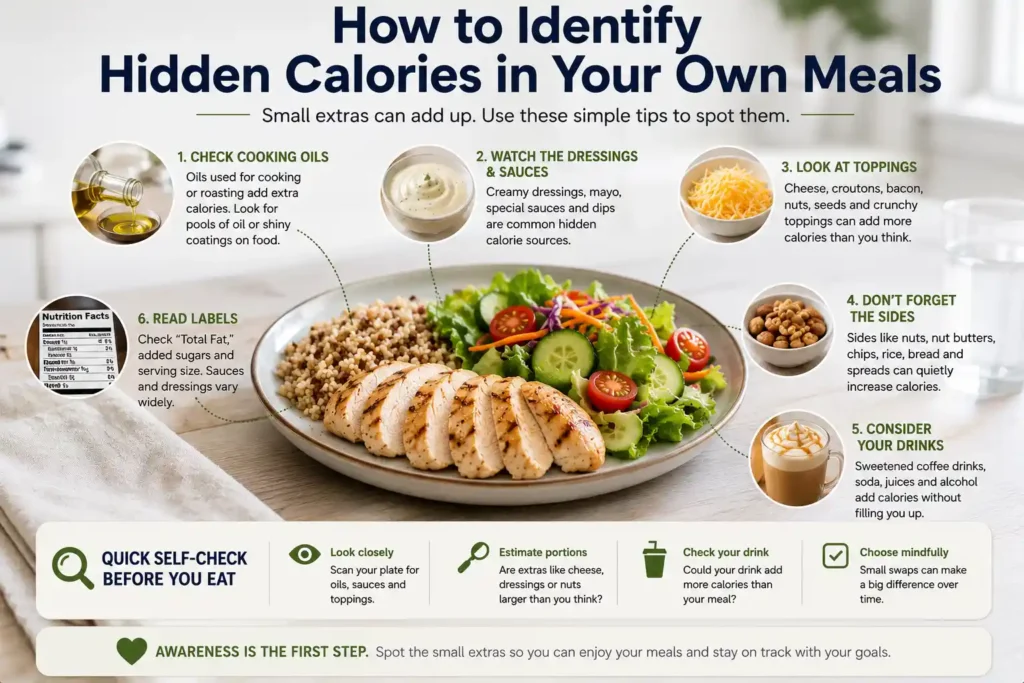
- Start with the main foods. Identify the protein, grains or starches, fruits and vegetables that make up the meal.
- Look for added fats. Ask whether the food was cooked with oil, butter or another fat.
- Check sauces and toppings. Include dressing, cheese, mayonnaise, gravy, dips and other additions.
- Count the beverage. Consider milk, cream, sugar, syrups and sweetened drinks.
- Compare your portion with the serving size. For packaged foods, check both the serving size and servings per container. The Nutrition Facts label generally provides calorie information per serving, so eating two servings means consuming twice the listed calories.
How to Read the Nutrition Facts Label More Accurately
The Nutrition Facts label is one of the most useful tools for identifying overlooked calories in packaged foods. Start near the top rather than jumping directly to the calorie number.
First, check serving size. FDA guidance explains that serving sizes are based on amounts people typically consume, not necessarily the amount an individual should eat. U.S. Food and Drug Administration
Next, check servings per container. If you eat two servings, you need to account for twice the calories and other nutrients listed for one serving.
Then review calories. Calories represent the energy provided by carbohydrate, fat, protein and alcohol in the food or beverage. The FDA uses 2,000 calories per day as a general reference for nutrition advice, but individual calorie needs can be higher or lower.
U.S. Food and Drug Administration
Finally, look beyond calories. Added sugars, saturated fat, sodium, fiber and protein can provide useful context when deciding whether a food fits your overall eating pattern. The CDC recommends using Nutrition Facts labels to help monitor nutrients such as fats, sodium and added sugars.
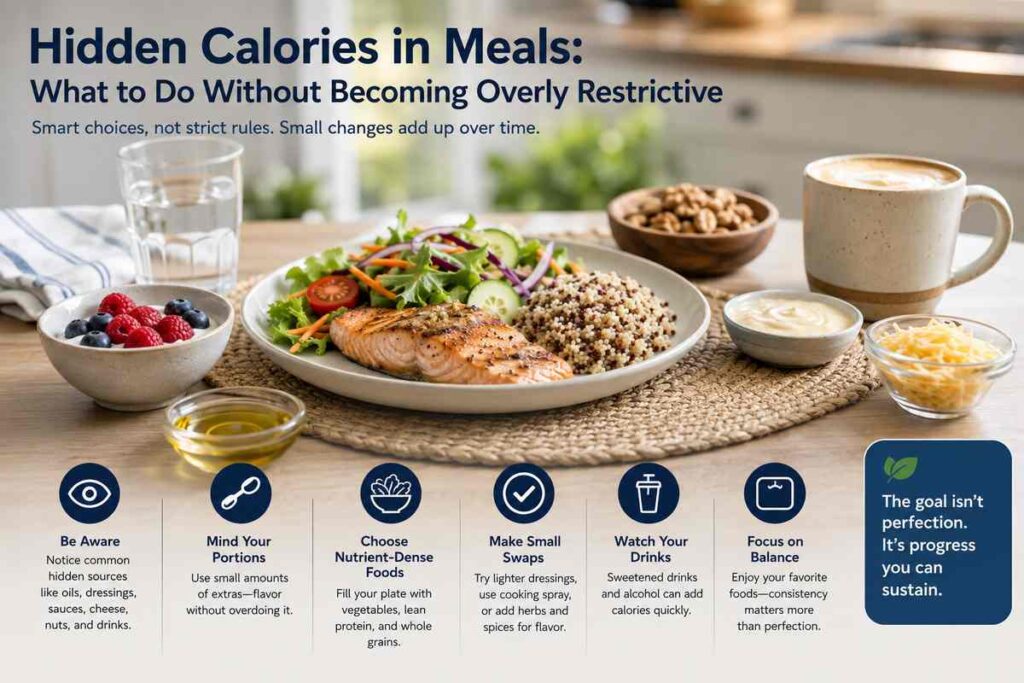
Hidden Calories in Meals: What to Do Without Becoming Overly Restrictive
Finding hidden calories does not mean you need to remove every calorie-dense ingredient from your diet. Oils, nuts, seeds, avocado, dairy foods and other calorie-containing foods can provide useful nutrients and can be part of a balanced eating pattern.
A better strategy is to decide which additions are most important to you. For example, you might keep a favorite dressing but use a measured amount. You might enjoy cheese on a sandwich while skipping an additional creamy sauce. Or you might choose an unsweetened drink when the meal already contains several calorie-dense components.
The CDC recommends practical habits such as prioritizing protein foods, fruits and vegetables, fiber-rich whole grains and healthy fats while limiting excess added sugars and highly processed foods.
Simple Swaps That Can Make Calories Easier to Track
- Use a measured amount of oil rather than pouring directly from the bottle.
- Serve salad dressing on the side.
- Choose unsweetened coffee or tea when you do not want beverage calories.
- Use whole fruit instead of fruit juice when appropriate; whole fruit provides fiber and can be more filling.
- Measure calorie-dense toppings such as nuts, seeds, granola and nut butter when portion awareness is important.
- Check restaurant menus for nutrition information when available.
- For packaged foods, compare the portion you actually eat with the listed serving size.
- Keep calorie-dense ingredients when you enjoy them, but be intentional about how much you use.
A Quick Hidden-Calorie Checklist
Before deciding that a meal is lower in calories than expected, ask yourself:
- Was oil or butter used during cooking?
- Is there a sauce, gravy, dressing or dip?
- Was cheese added?
- Are there nuts, seeds, granola or other toppings?
- Did I add mayonnaise, spread or another condiment?
- Does my drink contain sugar, milk, cream or syrup?
- Is the portion larger than the serving size?
- Was the food prepared at a restaurant where ingredients are harder to estimate?
If you answer yes to several questions, your initial estimate may not include the full meal. That does not mean the meal is unhealthy; it simply means the calorie estimate deserves another look.
When You Do Not Need to Count Every Calorie
Calorie awareness can be useful, but detailed tracking is not necessary or appropriate for everyone. A healthy eating pattern is about more than a single calorie number. Food quality, nutritional adequacy, hunger and fullness, personal preferences, culture, budget and medical needs all matter.
If calorie counting becomes stressful, obsessive or disruptive to eating normally, consider stepping back from detailed tracking and speaking with a qualified healthcare professional or registered dietitian for individualized guidance.
For people who do track food, accuracy does not require perfection. Consistently noticing major sources of added energy, such as cooking fats, beverages, sauces and portion differences, may be more practical than trying to calculate every ingredient to the gram.
Summary
Learning to identify hidden calories in meals is mostly about noticing what is easy to overlook. Cooking oils, butter, dressings, sauces, cheese, nuts, spreads, sweetened drinks and larger portions can all change the energy content of a meal without changing its appearance very much.
The most useful habit is to look at the whole meal rather than just its main ingredient. Check how food was prepared, what was added on top, what you are drinking and how your portion compares with the listed serving size. At the same time, remember that calorie-dense does not automatically mean unhealthy. Many nutrient-rich foods contain calories and can be part of a balanced diet.
Think of hidden-calorie awareness as a tool for understanding your eating pattern—not as a reason to fear food or pursue perfect numbers.
Medical disclaimer: This article is for general educational and informational purposes only and is not a substitute for professional medical advice, diagnosis or treatment. Individual calorie and nutrition needs vary based on factors such as age, body size, activity level, health conditions, medications and other circumstances. If you have personal nutrition concerns, a history of disordered eating, or a medical condition that affects your diet, consult a qualified healthcare professional or registered dietitian. If you experience emergency symptoms or a medical emergency, seek appropriate emergency care.
Also Read More –Foods for a Healthy Gut: Best Choices for Digestion and the Gut Microbiome