
Learn how to start strength training for beginners with simple exercises, a 4-week workout plan, sets and reps, equipment tips, safety guidance, and progression strategies.
Strength Training for Beginners
Starting strength training can feel intimidating when you’re surrounded by barbells, dumbbells, machines, and complicated workout programs. The good news is that beginners do not need advanced equipment or heavy weights to start getting stronger.
Strength training, also called resistance training, involves challenging your muscles against resistance. That resistance can come from your body weight, resistance bands, dumbbells, machines, or other equipment. The U.S. physical activity guidelines recommend that adults perform muscle-strengthening activities involving the major muscle groups on at least 2 days per week.
For a beginner, the priorities are simple: learn the movements, use manageable resistance, train consistently, and increase the challenge gradually.
What Is Strength Training?
Strength training is exercise that makes your muscles work against resistance.
Examples include:
- Squats
- Push-ups
- Lunges
- Rows
- Resistance-band exercises
- Dumbbell exercises
- Weight-machine exercises
- Bodyweight exercises
You don’t have to lift extremely heavy weights to participate in strength training.
The National Institute on Aging describes muscle-strengthening activity as exercise that requires muscles to contract against resistance and notes that gradual increases in weight, repetitions, sets, or training frequency can help build strength.
Why Should Beginners Do Strength Training?
Strength training can provide benefits beyond simply building bigger muscles.
Regular resistance training can help improve:
- Muscular strength
- Physical function
- Muscle maintenance
- Bone health
- Ability to perform everyday activities
- Overall fitness
For older adults in particular, maintaining strength can help with activities such as getting out of a chair, climbing stairs, and carrying groceries.
Strength training can also complement aerobic exercise such as walking, cycling, or swimming.
A well-rounded exercise routine doesn’t have to be complicated. The goal is to combine different forms of activity that support your health and fitness.
How Often Should Beginners Do Strength Training?
For most adults, a good starting point is 2 strength-training sessions per week.
Federal physical activity guidance recommends muscle-strengthening activity on at least 2 days each week.
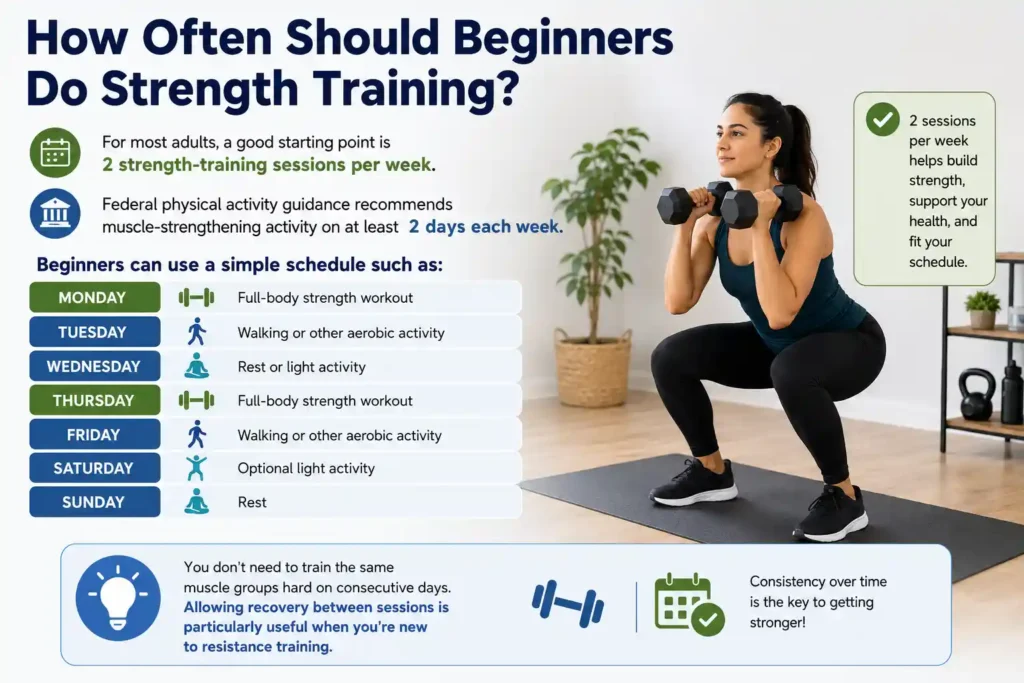
Beginners can use a simple schedule such as:
Monday: Full-body strength workout
Tuesday: Walking or other aerobic activity
Wednesday: Rest or light activity
Thursday: Full-body strength workout
Friday: Walking or other aerobic activity
Saturday: Optional light activity
Sunday: Rest
You don’t need to train the same muscle groups hard on consecutive days. Allowing recovery between sessions is particularly useful when you’re new to resistance training.
How to Start Strength Training
You can begin with four basic steps.
1. Choose simple exercises
Start with movements that train the major muscle groups.
2. Learn proper technique
Don’t worry about lifting heavy immediately.
3. Start with manageable resistance
The resistance should challenge you without forcing you to sacrifice good form.
4. Progress gradually
As exercises become easier, gradually increase the resistance, repetitions, sets, or difficulty.
Cleveland Clinic similarly recommends that beginners start with bodyweight or resistance-band exercises, learn proper form, and gradually progress to machines, dumbbells, or free weights.
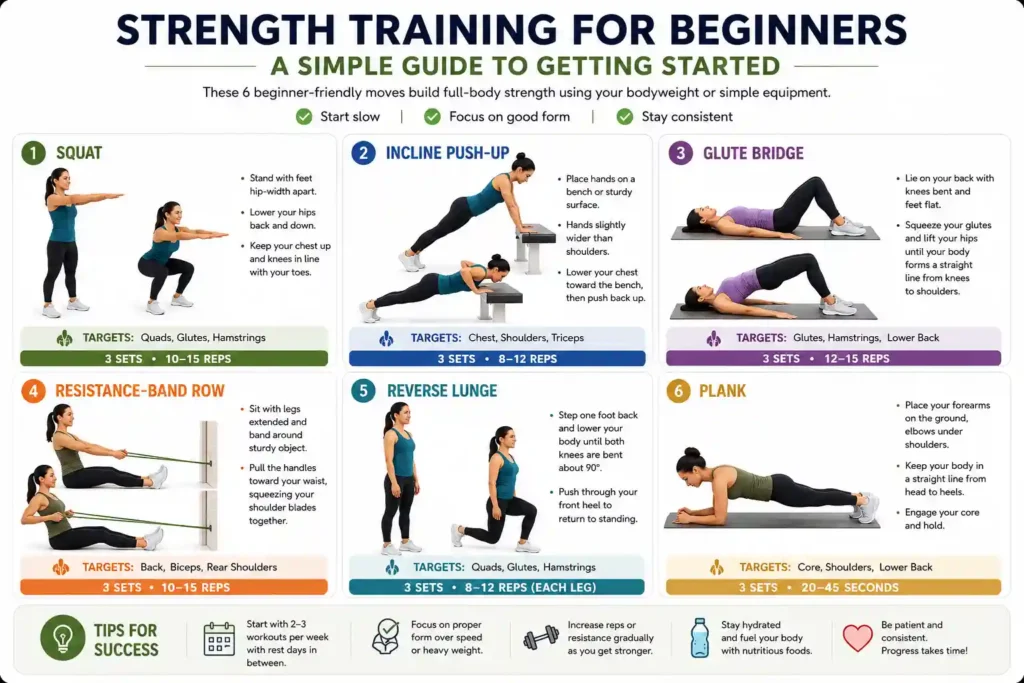
8 Best Strength Exercises for Beginners
You don’t need dozens of exercises. Start by learning a small number of fundamental movement patterns.
1. Bodyweight Squat
Works: thighs, hips, and glutes.
Stand with your feet approximately shoulder-width apart. Bend your knees and hips while lowering your body in a controlled manner, then push through your feet to return to standing.
Beginner option: Use a chair behind you as a target for a controlled sit-to-stand movement.
2. Wall or Incline Push-Up
Works: chest, shoulders, and arms.
Place your hands against a wall or sturdy elevated surface. Keep your body relatively straight as you bend your elbows and bring your chest toward the surface, then push away.
As you become stronger, progress from a wall to a lower elevated surface and eventually toward floor push-ups if appropriate.
3. Glute Bridge
Works: glutes and muscles around the hips.
Lie on your back with your knees bent and feet on the floor. Lift your hips in a controlled movement, squeeze your glutes gently at the top, then lower.
This can be a useful beginner-friendly way to practice hip extension.
4. Reverse Lunge
Works: legs and glutes.
From a standing position, step one foot backward and lower your body under control. Push through the front foot to return to the starting position.
Beginner option: Hold onto a stable surface for balance.
5. Resistance-Band Row
Works: upper back and arms.
Secure a suitable resistance band according to the manufacturer’s instructions. Pull the band toward your body while keeping your movements controlled, then slowly return to the starting position.
Rows help balance pressing movements by training the muscles of the back.
6. Dumbbell Romanian Deadlift
Works: glutes and hamstrings.
Hold light dumbbells and hinge at your hips while keeping your back in a comfortable neutral position. Lower the weights only as far as you can maintain good control, then return to standing.
Because hip-hinge exercises require technique, beginners should practice the movement with little or no weight before adding resistance.
7. Dumbbell Shoulder Press
Works: shoulders and arms.
Hold light dumbbells near shoulder height and press them upward in a controlled movement.
If overhead movement causes pain or discomfort, choose another exercise or seek professional guidance.
8. Plank
Works: core and trunk muscles.
Support your body with your hands or forearms and feet while maintaining a controlled body position.
Beginners can start with a short hold rather than trying to hold a plank for several minutes.
Beginner Full-Body Strength Workout
You don’t need to perform all eight exercises in one session.
Here’s a simple starting routine:
| Exercise | Sets | Repetitions |
| Bodyweight squat | 1–2 | 8–12 |
| Incline push-up | 1–2 | 8–12 |
| Glute bridge | 1–2 | 8–15 |
| Resistance-band row | 1–2 | 8–15 |
| Reverse lunge | 1–2 | 6–10 each side |
| Plank | 1–2 | 10–30 sec |
Start conservatively.
The National Institute on Aging notes that one set of 8–12 repetitions can be effective, while two or three sets may provide additional benefit.
You do not need to train until complete exhaustion.
How Much Weight Should a Beginner Lift?
There is no single correct starting weight.
The right resistance should allow you to perform the exercise with controlled technique while still making the final repetitions challenging.
If you cannot maintain proper form, the resistance may be too heavy.
If you can perform many more repetitions easily and feel almost no challenge, you may eventually need more resistance.
For your first few sessions, prioritize technique over weight.
Mayo Clinic recommends starting with light to moderate weights and increasing resistance gradually rather than immediately trying to lift heavy.
How Many Reps Should Beginners Do?
A practical starting range is often 8–12 controlled repetitions for many exercises.
But repetitions are not a magic number.
Some exercises may naturally use different ranges, particularly bodyweight movements, smaller muscle exercises, or exercises performed for balance and stability.
The more important principle is that the exercise provides an appropriate challenge while allowing safe, controlled movement.
How Long Should a Beginner Strength Workout Last?
You don’t need a two-hour gym session.
A beginner full-body workout can often be completed in roughly 20–40 minutes, depending on the number of exercises, sets, rest periods, and your experience.
A simple structure is:
5–10 minutes: Warm-up
20–25 minutes: Strength exercises
A few minutes: Easy cooldown or additional mobility work if desired
Consistency matters more than making every workout long.
Should You Warm Up Before Strength Training?
A brief warm-up can help prepare you for exercise.
Try 5–10 minutes of easy movement such as:
- Brisk walking
- Marching in place
- Easy cycling
- Gentle dynamic movements
Then perform a few easier repetitions of your first strength exercise.
Mayo Clinic recommends warming up before weight training and starting with lighter resistance.
How to Progress in Strength Training
Progressive overload doesn’t mean adding huge amounts of weight every workout.
You can progress by gradually increasing:
- Resistance
- Repetitions
- Sets
- Exercise difficulty
- Range of motion
- Training frequency, when appropriate
For example:
Week 1: Squat — 2 sets of 8
Week 2: Squat — 2 sets of 10
Week 3: Squat — 2 sets of 12
Week 4: Slightly increase resistance and return to a lower repetition range
The exact progression should depend on how you respond to training.
NIA specifically notes that gradual increases in weight, sets, repetitions, or training days can lead to stronger muscles.
Strength Training at Home
You don’t need a gym to start.
A beginner home workout can use:
- Body weight
- Resistance bands
- A pair of light dumbbells
- A sturdy chair
- A mat
Bodyweight exercises such as squats, lunges, push-ups, and planks can provide resistance without traditional gym equipment.
As you progress, you can add dumbbells or resistance bands if you want additional challenge.
Strength Training at the Gym
A gym provides more equipment and resistance options.
Beginners may find these useful:
- Leg press
- Chest press
- Seated row
- Lat pulldown
- Cable machines
- Dumbbells
Machines can be particularly useful when you’re learning how to control resistance.
If you’re unsure how to adjust or use a machine, ask qualified gym staff or a fitness professional rather than guessing.
Do Beginners Need Supplements?
No.
You do not need supplements to begin strength training.
A balanced eating pattern can provide the nutrients needed to support an active lifestyle.
Depending on individual circumstances, some people may have specific nutritional needs, but supplements should not be treated as a requirement for getting started.
Be especially cautious with products marketed as:
- Muscle-building shortcuts
- Testosterone boosters
- Fat burners
- “Natural anabolic” products
- Rapid recovery formulas
Marketing claims do not necessarily reflect strong scientific evidence.
What Should Beginners Eat for Strength Training?
Focus on a balanced diet that includes:
- Protein-rich foods
- Vegetables
- Fruits
- Whole grains
- Beans and lentils
- Healthy fats
- Adequate fluids
Protein foods can include:
- Eggs
- Fish
- Chicken
- Greek yogurt
- Cottage cheese
- Beans
- Lentils
- Tofu
- Tempeh
Your exact calorie and protein needs depend on your body, activity level, goals, and health status.
Should You Do Cardio and Strength Training Together?
Yes.
Strength training and aerobic exercise serve different purposes and can complement each other.
For general health, adults should aim for at least 150 minutes of moderate-intensity aerobic activity per week as well as muscle-strengthening activity on at least two days.
A balanced weekly routine might look like:
- Monday: Strength
- Tuesday: Brisk walk
- Wednesday: Rest or light movement
- Thursday: Strength
- Friday: Brisk walk
- Saturday: Longer walk or other aerobic activity
- Sunday: Rest
You can adjust this schedule around your lifestyle.
Strength Training for Weight Loss
Strength training can be useful during a weight-management program, but it shouldn’t be presented as a magic fat-burning workout.
When trying to lose weight, a combination of:
- Appropriate nutrition
- Regular physical activity
- Strength training
- Aerobic activity
- Adequate sleep
- Sustainable habits
can be more useful than relying on one type of exercise.
Strength training is particularly valuable because it challenges muscles and can help maintain strength and physical function.
Strength Training for Older Beginners
It’s never too late to start becoming stronger, but older adults may need to consider balance, mobility, existing medical conditions, and previous injuries.
NIA recommends muscle-strengthening activity at least two days per week and emphasizes adapting exercises to individual fitness levels and abilities.
Beginners may start with:
- Sit-to-stand exercises
- Wall push-ups
- Resistance-band rows
- Supported lunges
- Light dumbbells
- Balance exercises
If you’re unsure whether a movement is appropriate for you, ask a healthcare professional or physical therapist for individualized guidance.
Common Beginner Strength-Training Mistakes
Starting Too Heavy
More weight does not automatically mean better results.
Learn the movement first.
Doing Too Much Too Soon
A beginner doesn’t need six workouts every week.
Start with a manageable schedule.
Ignoring Technique
Poor technique can make an exercise less effective and may increase injury risk.
Training Through Sharp Pain
Muscle fatigue and ordinary post-exercise soreness aren’t the same as sharp or worsening pain.
Stop an exercise that causes concerning pain and get appropriate advice if necessary.
Never Progressing
Once an exercise becomes consistently easy, you may need to gradually increase the challenge.
Comparing Yourself With Experienced Lifters
Someone who has trained for five years should not be your benchmark during your first month.
Measure your progress against your own starting point.
Is Muscle Soreness Normal After Strength Training?
Some beginners experience delayed-onset muscle soreness (DOMS) after unfamiliar exercise.
Mild soreness can occur after introducing new movements or increasing training.
However, severe pain, significant swelling, loss of function, or persistent symptoms should not simply be dismissed as normal soreness.
Healthdirect notes that DOMS can occur after strength training and generally resolves over several days, while also recommending avoiding exercises that cause pain and allowing recovery.
How Much Rest Do Beginners Need?
Recovery is part of training.
You don’t need to train the same muscle groups hard every day.
A simple beginner approach is to leave at least one day between full-body strength sessions.
For example:
Monday → Strength
Tuesday → Rest or cardio
Wednesday → Rest or light movement
Thursday → Strength
This gives your muscles time to recover before another challenging session.
When Should You Get Professional Guidance?
Consider working with a qualified fitness professional or healthcare professional if:
- You’re completely unfamiliar with resistance training
- You have a significant injury
- You have a chronic medical condition affecting exercise
- You have substantial joint pain
- You recently had surgery
- You are returning to exercise after a long period of inactivity
- You’re unsure how to perform an exercise safely
NIA recommends seeking guidance from a doctor or physical therapist when you’re uncertain about a particular movement.
4-Week Beginner Strength Training Plan
Week 1
2 workouts
Focus on:
- Learning technique
- Bodyweight movements
- Light resistance
- Controlled repetitions
Week 2
2 workouts
Focus on:
- Repeating the basic movements
- Improving consistency
- Adding a few repetitions where appropriate
Week 3
2 workouts
Focus on:
- Slightly increasing resistance or repetitions
- Maintaining good technique
- Avoiding unnecessary fatigue
Week 4
2–3 workouts if appropriate
Focus on:
- Gradual progression
- Better movement control
- Establishing a sustainable routine
You don’t have to increase the workload every week. Sometimes repeating the same workout until it feels comfortable is the right progression.
Beginner Strength Training Checklist
Before your workout:
- Choose a few basic exercises.
- Clear enough space to move safely.
- Have appropriate footwear if needed.
- Warm up.
- Start with manageable resistance.
During your workout:
- Use controlled movements.
- Breathe normally.
- Prioritize technique.
- Stop if you experience concerning pain.
- Don’t worry about lifting as much as possible.
After your workout:
- Give your muscles time to recover.
- Eat a balanced diet.
- Stay hydrated.
- Record your workout if tracking progress helps you stay consistent.
Frequently Asked Questions
How often should a beginner do strength training?
Most beginners can start with 2 full-body sessions per week, consistent with the federal recommendation that adults perform muscle-strengthening activity at least two days per week.
Is 20 minutes of strength training enough for beginners?
Yes. A short, focused workout can be a useful starting point. The goal is to train major muscle groups consistently rather than making every workout as long as possible.
Should beginners lift weights?
Yes, if they can do so safely. But beginners can start with bodyweight exercises or resistance bands before progressing to dumbbells, machines, or other weights.
What is the best strength exercise for beginners?
There isn’t one best exercise. A beginner routine should include movements that train the major muscle groups, such as squats, pushes, pulls, hip-hinge movements, and core exercises.
How many sets should a beginner do?
One set can be effective, while two or three sets may provide additional benefit. Start with a manageable amount and increase gradually.
How many repetitions should beginners do?
A range of roughly 8–12 controlled repetitions works well for many beginner exercises, although the appropriate range varies by movement and individual goals.
Do I need a gym to strength train?
No. Bodyweight exercises and resistance bands can provide effective resistance training at home.
Should I train when I’m sore?
Mild muscle soreness doesn’t necessarily mean you must stop all activity, but avoid aggressively training a muscle group that hasn’t recovered. Sharp, severe, or worsening pain should not be treated as ordinary soreness.
Can strength training help with weight loss?
Strength training can be part of a weight-management program, particularly when combined with an appropriate eating pattern and aerobic activity. It should not be presented as a guaranteed weight-loss method.
Is strength training safe for beginners?
Strength training can be appropriate for many people when exercises are performed with suitable resistance and technique. People with medical conditions, injuries, or special circumstances may need individualized guidance.
Can I strength train every day?
Beginners generally don’t need to perform challenging full-body strength workouts every day. Recovery between sessions is important, particularly when training the same muscle groups.
How long does it take to get stronger?
Progress varies. Beginners may notice improvements in movement control and strength as they consistently practice, but the timeline depends on training, recovery, nutrition, age, and individual factors.
Friendly Summary
Strength training for beginners involves using resistance to challenge the major muscle groups through exercises such as squats, push-ups, rows, lunges, hip hinges, and core movements. Beginners can start with bodyweight exercises, resistance bands, light dumbbells, or machines. U.S. guidelines recommend that adults perform muscle-strengthening activities on at least 2 days per week.
A beginner should prioritize proper technique, manageable resistance, gradual progression, and recovery rather than trying to lift heavy weights immediately. Strength training can complement aerobic exercise and support muscular strength, physical function, and healthy aging.
Read More –Walking for Weight Loss: How Much Should You Walk?